A Beginner’s Guide
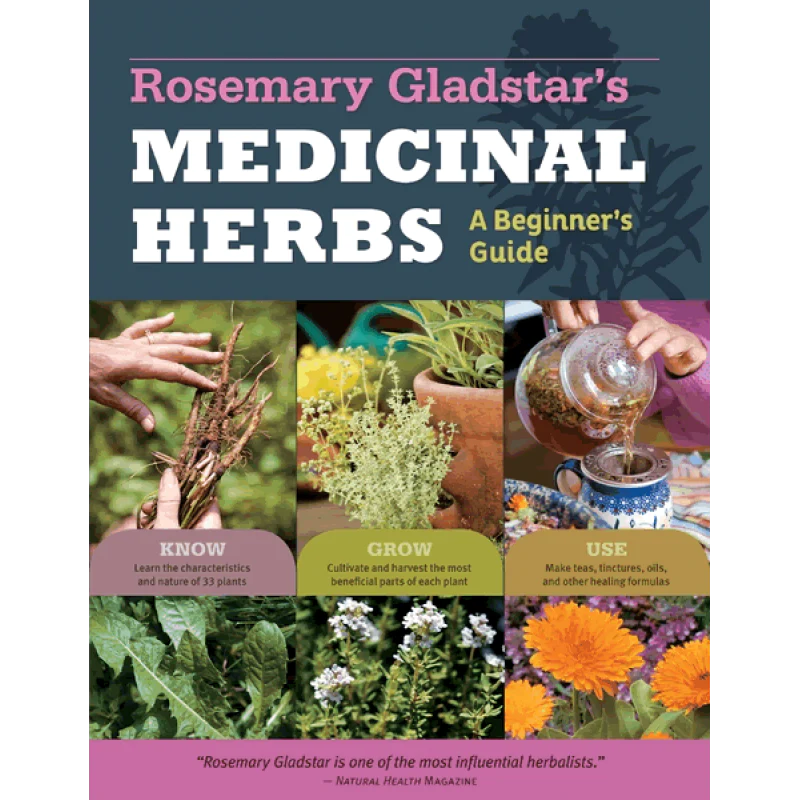
You won’t wander too deep in the world of herbalism before you hear the name Rosemary Gladstar. Rosemary Gladstar is a well-known herbalist who has been an extraordinary contributor of her knowledge of herbalism. Whenever I see her name among featured speakers, I am confident in knowing that the information will be credible and loaded with valuable information. Rosemary Gladstar has authored several books, and her work is referenced in other books, articles, and other works of those within the herbalism spectrum. The second book on my list is Rosemary Gladstar’s Medicinal Herbs: A Beginner’s Guide.
As a budding herbalist (someone who’s just beginning to learn herbalism) I have several books on herbs, from herbal encyclopedias, DIY recipes, and academic herbalism textbooks to gardening books, and more. I am pursuing my studies to prepare me to become a clinical herbalist, so I dabble in a lot of ‘this’ and plenty of ‘that’. Herbalism is a very broad area, and I am all over the place. For the sake of growing my own herbs, I must be equipped with proper gardening methods; to learn benefits, I must learn a bit of anatomy along with plant constituents; for holistic body care I must know a tad bit about skin functions, skin types, and more; for spiritual and emotional healing, I must be familiar with mental health, herbal energetics, and a plant’s connection with spirituality (plant’s connection to chakras, astrology, yin/yang, for example). Sage, for example, is used to cleanse spaces of negative energy; lavender is commonly used for relaxation, and quieting a ‘loud’, busy mind.
I say all of this because there are so many avenues to take on the journey of learning herbalism, and tons of outlying areas that must be addressed, at least on a basic level, for proper guidance and understanding. Rosemary Gladstar shines here! I have witnessed a nice variety of platforms where she has shared her knowledge, and it’s always pleasurable, insightful, and a joy to hear what she has to say!
Medicinal Herbs Chapter Breakdown
When you first pick up the book, you’re welcomed with the beauty of a few herbs, in their true, natural form. On the cover shines the vibrant green, yellow, orange, and white colors of leaves and flowers. What’s more is the three focus areas: know, grow, and use. These are the highlights that prepare you for the herbal journey that lies ahead. On the back cover is an image of tincture bottles, a small dish of DIY herbal supplements, a jar filled with some herbal concoction, and a cup filled with tea. Off to its side lies a list of highlighted medicinal recipes (of 124!) that Rosemary Gladstar will share within these two covers. I love herbalism, and the beauty of working with nature excites me. Whenever I see tea (especially coupled with a beautiful teacup or mug), tincture bottles, or herbal-making supplies, I get extremely excited!
Chapter 1: Welcome to the Wonderful World of Medicinal Herbs
Medicinal Herbs is broken into four chapters. The first chapter is a brief introduction about herbalism, as well as the author, Rosemary Gladstar. As I mentioned in the Spiritual Herbalism post, I love hearing the stories behind someone’s motivation and passion. Rosemary Gladstar shares her beautiful story (and even a childhood image of her on her childhood farm), and expresses that the foundation of her herbal knowledge began early-on with days on the farm with her grandmother.
In chapter one she addresses several basic points of herbalism, including, balancing allopathic (conventional) and herbal medicine, benefits of herbal medicine, harvesting herbs, and other methods. With these insights, she shares colorful images, and details the process. When discussing harvesting, for example, she explains key points about buds and flowers, leaves, and roots. She explains the best time to harvest, and things to look out for when trying to determine quality. When she talks about drying herbs, she has pictures of different methods of drying herbs–baskets, drying rack, and even a DIY herb line (what I call the herb-equivalent of a clothes line, lol).
Chapter 2: How to Make Your Own Herbal Remedies
Chapter two focuses on how to make your own herbal remedies. Had it not been that I’ve already read, several times over, how to prepare herbal concoctions, I think chapter two would have been my favorite one. I do enjoy diversity, so I always read through each individuals’ methods on preparations just to see what personal touches are added, or any recommendations they may have from experience.
This section details the steps to making common remedies such as syrups, tinctures, oils, herbal pills, and more. She also includes measuring and conversion charts, common dosage recommendations, and valuable tips to help you along the way. The images are all in color, and seeing the preparations motivate you to want to get right to it! She details proper labeling practices, and the included images help you to have an understanding of how your product should look at a given point in the process.
I believe this is helpful for those just starting out. A lot of times, I’ve called myself following a recipe, only to end up with a completely different consistency than what the recipe called for. Being able to verify this within the process compared to after, makes a difference in, obviously, your product, but also in building confidence as an herbalist.
I love the vibe felt as I read over the steps–I felt warm, loving, grandmother energy patiently guiding me along. Rosemary Gladstar provides wonderful explanations about what each remedy does, what’s needed to prepare them, and how to use them. This chapter is referenced throughout the rest of the book for recipes that call for one or more of the methods mentioned here (there are several!).
Chapter 3: 9 Familiar Herbs & Spices to Grow & Use
The third chapter is one of my favorite chapters. Chapter three highlights nine familiar herbs and spices to grow and use. I love it because it chimes in on common, accessible herbs. Chapter three is so valuable because it takes everyday herbs and breaks down the herbal profiles (an herb’s benefits, properties, constituents, ect.) for each one. There are only nine herbs included here, but there are several recipes included for each one. Recipes include teas, poultices, tinctures, treatment for ailments (like headaches, colds), and even herbal meal items.
I live in a pretty rural area, and often, I have to drive to Greenville, NC (the closest city to me) to get quality herbs and produce. I remember once that I was having trouble finding a honey substitute, so I asked one of the employees where it would be located in the store (it should have been on the aisle with the honey and syrups). I don’t remember which syrup it was, but I remember the look he gave me. Of course questions followed, and he had no clue what I was talking about. He walked me over to the produce area where some of the local farmers’ products were. I knew it wouldn’t be there.
As we now have immediate access to information, it’s easy to stumble across ingredients that are not well-known in recipes. The international aisles in the local grocery stores here feature common Asian and Mexican items, nothing out of the ordinary. Many people here have little knowledge and experience with anything beyond our cultural norms. Most ‘exotic’ ingredients I see in recipes are not readily available to me; most of these aren’t exotic at all, but I’d definitely have to make a short commute to Greenville to purchase them. To give you a clearer picture, my hometown features two grocery stores–Piggly Wiggly, and Food Lion. Before Piggly Wiggly, we had Winn Dixie, a store I’ve only since seen in my travels deeper south.
Getting back to the topic at hand, Rosemary Gladstar guides you, and allows you to explore the value of common herbs that probably sit right in your kitchen cabinet. She begins addressing each herb with a brief summary, often referencing ancient uses and customs. Every one pretty much knows what spices they’re reaching for during meal prep, but many are unaware of the actual medicinal benefits these herbs offer. Rosemary Gladstar includes tips on growing the herb, its medicinal uses, and includes safety factors to consider. It’s an amazing way to get started in learning the basics of herbalism, right in your own kitchen!
Chapter 4: 24 Safe & Effective Herbs to Know, Grow & Use
My favorite chapter! There isn’t really much to delve into because chapter 4 is basically and extension of chapter 3. Chapters 1 and 2 can be considered the foundation. Rosemary Gladstar has a commentary on the last page of chapter 2, where she says “…congratulations for completing Herbal Medicine Making 101…”. As mentioned before, chapter 2 is referenced throughout the entire book.
Chapter 4 is different from 3 in that it focuses on a variety of plants you can grow on your own (chapter 3 focused on common spices and herbs). She goes into great detail about the plants and herbs mentioned here, addresses issues where a particular plant shines, and provides several recipes for each.
The structure is the same as chapter 3, where she shares basic background information, details on growing, medicinal uses, provides the plant profiles, and offers recipes for you to try. Chapter 4 took me a long time to get through because I like to read slowly so that I’m able to digest information. I also googled a few things I came across, as I wanted to become a bit more familiar with herbal properties and implementation in recipes. Some of the plants and herbs featured in chapter 4 are aloe vera, burdock, goldenseal, and mullein to name a few.
Following chapter 4 are resources, the index, and credits. The resources list different organizations, educational resources, suppliers of quality herbs, and more.
Summary
While I wouldn’t recommend this book for leisurely reading (it’s actually pretty boring in that case unless you REALLY enjoy reading about herbs), it’s an amazing resource for the budding herbalist! One benefit in reading through it though, is that you create a mental stamp of the resource, and you can easily reference it when needed in the future.
I intend to use this as a reference in my herbal studies, and will look to this to compare my own formulations. When I am handling a plant or herb mentioned here, I will head over to the page that can provide me a general insight. I have tons of books, but the simplicity of this one is great for those beginning to experiment without the herbal and technical jargon that you get with the ‘in-depth’ herbal learning resources.
My mind gets overwhelmed easy with loads of information thrown at me at once, so this is a handy guide that you can reference and work through with ease! Also, I love Rosemary Gladstar’s methods and pace as a teacher of herbalism. Her nature has been calm, sweet, and nurturing anytime I’ve ever been in attendance where she has shared her knowledge. I love learning from those with practical experience, and the tips and tricks she throws in definitely helps you better connect with her and the study of herbalism.
Learn more about Rosemary Gladstar by clicking on the links below!
The Science & Art of Herbalism–Rosemary Gladstar’s homestudy platform; access courses & books, and learn more about Rosemary Gladstar.
Sage Mountain Botanical Sanctuary–founded by Rosemary Gladstar & family; connect with nature, has summer camps available (family-friendly), and education programs.
Traditional Medicinals Interview with Rosemary Gladstar–Rosemary Gladstar is the co-founder of Traditional Medicinals; learn more about her take on herbalism and more.
 Zenified Healing
Leave a comment